
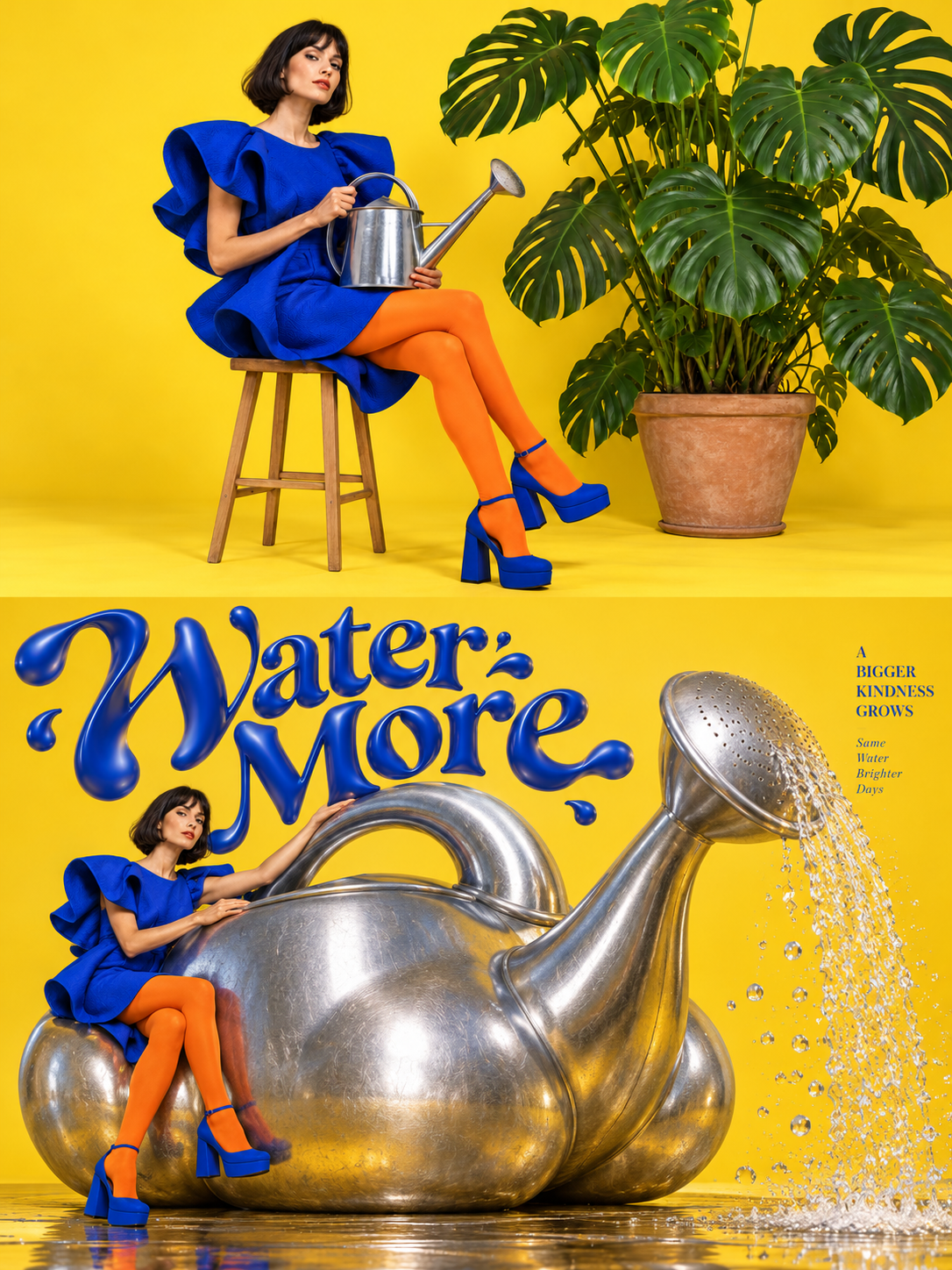

Experimental Art Poster Enlarging Everyday Objects
Prompt
For each uploaded real photo, create a separate 3:4 portrait experimental diptych poster; do not stitch or mix different photos.
The canvas must be strictly divided along the horizontal midline into two equal-height regions, each occupying 50%. The swelling, text, graphics, and layout may only appear in the lower half; they must not cross the boundary, change proportions, or add transition bands, frames, collages, cards, or shadows.

The upper half must be the original photo, fully preserving the identities, shapes, counts, clothing and accessories, poses and actions, positions, colors, materials, composition, perspective, lighting, and relationships of people, animals, plants, objects, buildings, and the environment. Only slight photographic color grading and natural extension of the original background to fit the canvas are allowed; do not stretch, repaint, replace, move, duplicate, or crop key subjects. The real photo must fill the area up to the top, left and right edges, and the central dividing line; the upper half must contain no text, symbols, graphics, or stylized effects.

The lower half must be based solely on the same original photo, analyzing subjects, space, and actions. If there is a person, select the single object that has the closest relationship to them (held, ridden, leaned on, embraced, sat/laid on, or used) and has the clearest silhouette as the object to be swollen; if there are no people, choose the most recognizable non-person subject or detail suitable for swelling. Independently distill an artistic concept, composition, color, typography, negative space, and layout for each photo; templates are prohibited.

In the lower half, transform the selected object or its parts into Organic Sculptural Swelling and Solid Volume Expansion: exaggerate the solid volume in a rounded, full, and substantial manner along the original geometry, load directions, and functional components. Pronounced surrealism is allowed, but the object's use, brand markings, original colors, key structures, and continuous connections must be preserved. Thin structures become thicker, hard edges soften, planes form continuous curved surfaces; do not replace every object with a sphere. The person themselves must retain identity, facial features, skeleton, proportions, clothing, and pose; only interacting objects are to be swollen. Fingers, limbs, contact, occlusion, load-bearing, perspective, and contact shadows must be natural and believable.

The swelling should be a change of the original solid material: leather remains leather, fabrics still show fibers, metals retain reflections, ceramics keep their glaze, plants keep veining, fruits keep their skin; present realistic density, thickness, weight, curved-surface shading, and environmental reflections. Absolutely forbid balloons, inflatable toys, air cushions, PVC, latex, rubber sheeting, valves, nozzles, heat-sealed edges, seams, hollow appearances, balloon highlights, and inflatable wrinkles. The lower half should use an artisticized environment matching the mood of the original image, realistic photographic lighting, and an independent experimental layout; automatically generate a related English title and a small amount of subtext, which may be creatively arranged along object curves, motion direction, or negative space, but must not obscure facial features, key structures of the swollen object, or interaction relationships. Prohibit floating elements, mesh penetration, incorrect contact, unrelated subjects, garbled text, fictional brands, logos, and watermarks. The final result: the top is the real moment, and the bottom is the same scene's surreal art poster after the original object has been swollen.
Input images
Summary
Please attach photos that include people and small objects. The upper half will feature the original photo, and the lower half will place a scene where objects held in the hand (or similar) are transformed into rounded, thick, gigantic sculptural forms. Make use of the materials' textures and produce a two-tier (top and bottom) art poster with an English headline. Example outputs follow the same order as the input images.