
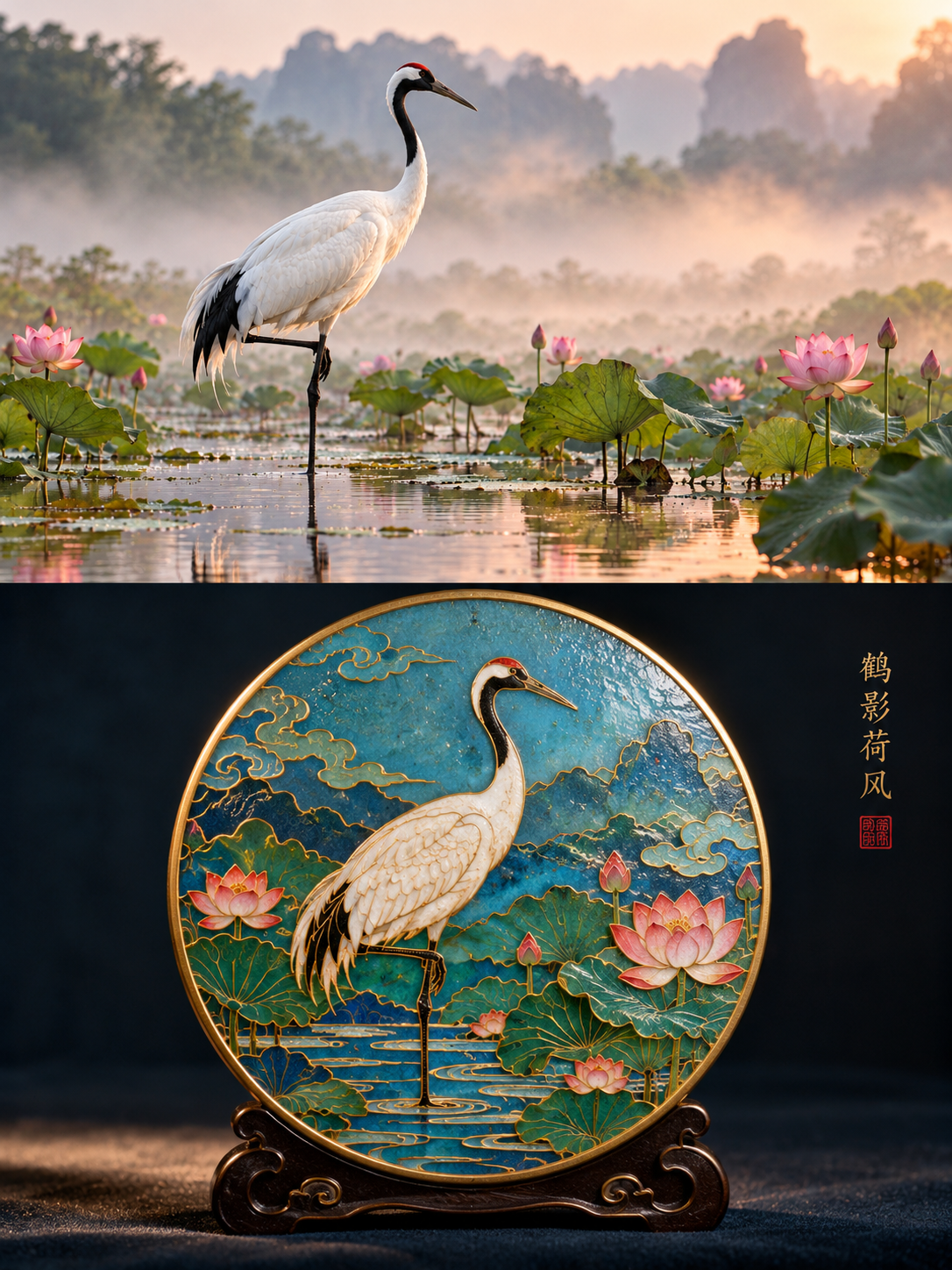
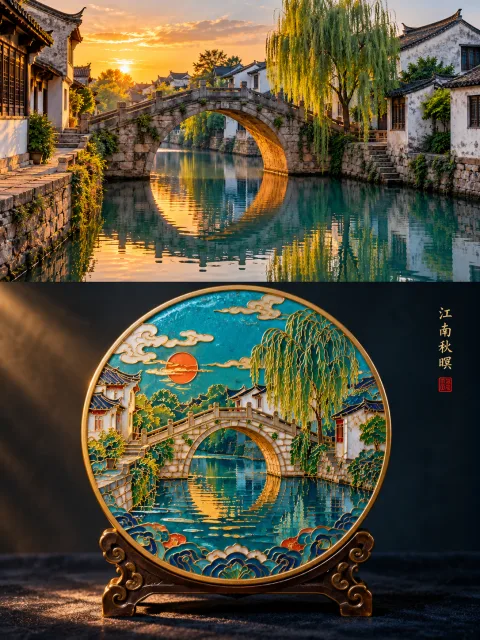
Turn the photo subject into cloisonné with gold wire and enamel glaze
Prompt
Please turn each photo I upload into an independent, high-end design poster — one photo per output, no multi-image collages. Use a 3:4 vertical composition overall, with the upper and lower regions strictly 1:1 in height, each occupying 50% of the canvas.

The upper half preserves the original photo, keeping the subject’s identity, structure, posture, real texture, natural light and shadow, and original color atmosphere, with only subtle high-end color grading to give it the feel of art photography and Eastern exhibition imagery. To fit the format, you may naturally extend the surrounding background, but do not stretch, distort, or alter the subject.

The lower half extracts the most identifiable subject, contour, pose, and narrative relationship from the photo and reconstructs it as a decorative motif on a Chinese traditional cloisonné (掐丝珐琅 / 景泰蓝 / cloisonné) object, presented on a warm-toned copper-bodied enamel screen plaque or circular enamel medallion. Whether the original is a person, animal, building, plant, object, or landscape, treat it as a “pattern that can be cloisonné-ed, enamel-painted, and fired”: the subject’s outline and internal structure are drawn by many narrow gilded copper wires, forming closed small compartments (wire cells); each cell is filled with a different color of enamel glaze; the pose is taken from the most expressive instant in the original photo, as if permanently frozen beneath the glaze.

Do not render photo-realistically or cartoonishly; instead re-summarize the subject using the formal grammar of cloisonné: linear, planar, and decorative. Use gold wires to delineate contours and employ traditional motifs such as lotus-scrolls, key-fret, ruyi-clouds, and “sea-and-cliff” patterns as local ornaments or background fills. Preserve the most recognizable features of the original so viewers can identify it at a glance, while making it feel as if an old master painstakingly formed the wires and repeatedly applied and fired the blue enamel.

Craft and luster are the soul of the piece: the gilded copper wires show soft yet distinct golden highlights under the light, like a delicate golden skeleton; the enamel surface, after multiple firings and polishing, has a glass-like, warm semi-translucent sheen, with subtle gradations of glaze depth, tiny bubbles, and hand-made marks. Enamel colors use the signature peacock-blue / sky-blue tone of Jingtai blue as the base, accented with coral red, gem blue, peacock green, ivory white, and goose yellow. A warm oblique side light falls across the object, creating refined highlights and shadows on the wires and enamel, with gentle edge reflections, like a treasure quietly displayed in a museum case.

Composition centers on one-object–one-pattern plus ample negative space. Place the enamel plaque or screen against a deep, dark background (e.g., deep indigo velvet, ebony lacquer, or a warm ink-toned field), with natural darkening toward the edges; the main ornament should occupy about 25%–35% of the frame, and may be off-center or positioned at a golden-ratio point. Leave large areas of plain monochrome enamel ground on the object (for example, a pure sky-blue field) as visual “blank” space—calm and breathable. Do not show cluttered displays, extra props, or a full gallery panorama.

Extract 2–3 of the most emotionally significant colors from the upper photo and translate them into enamel glazes that coordinate with the Jingtai-blue dominant tone; use deep indigo and warm ink tones for shadows rather than cold black; reserve gold only for the wires and object borders, used sparingly and precisely.

Text may be used minimally: a small vertical inscription in a corner naming the object or a short phrase, in the manner of an incised maker’s mark or a small vermilion seal, quietly placed in the negative space; language is not restricted.

Overall present a craft visual that combines gilded wires, glassy enamel sheen, Jingtai-blue tonality, oblique lighting, and Eastern negative space. Core principle: burn the photo’s protagonist into a piece of enamel, letting it be treasured between gold wires and glazes for a thousand years. Avoid full photographic realism, over-patterned clutter, cheap ‘Guochao’ trendiness, plastic feel, low-quality 3D rendering, cartoonishness, and templated poster aesthetics.
Input images
Summary
Use this with photos of animals, buildings, etc. Replace the photo’s form and colors with a traditional Chinese cloisonné enamel rendered in gold wires and blue glazes, arranging the original photo above and the crafted piece below to create a quiet exhibition poster. Example outputs follow the same order as the input images.