
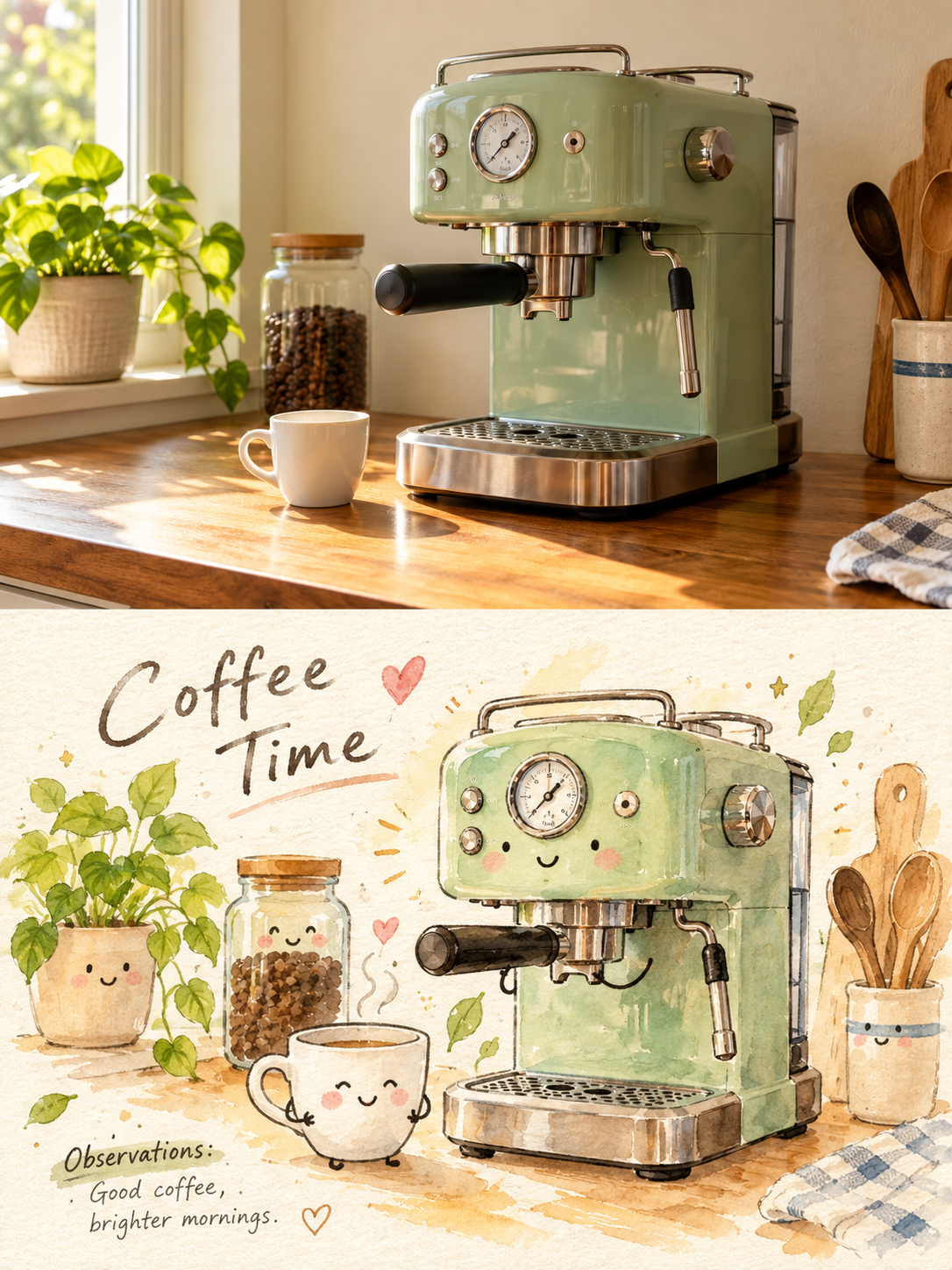
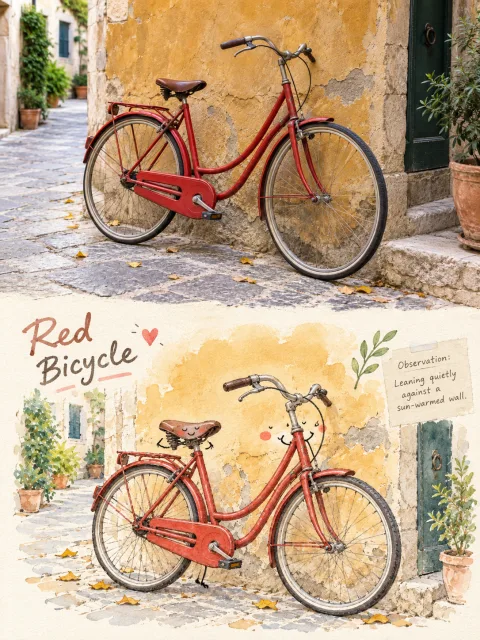
Turn a Photo into a Gentle Watercolor Journal
Prompt
Use one input real photo to generate a vertical 3:4 portrait-style, top-and-bottom comparison journal poster. The upper half must strictly preserve the input photo's real photography: the subject's identity, number, pose/placement, key contours, original lighting, viewpoint, and background relationships must all be accurate. The photo may receive only slight publication-style color grading and must not be turned into an illustration. The lower half must be a redraw of the same photo content as a comforting watercolor food-personification observation journal: extract the subject and main supporting elements from the original photo and reorganize them into a transparent watercolor illustration on an off-white paper page; keep recognizable shapes, colors, and spatial cues, but allow scaling down, cropping, generous white space, and changes in information density. The subject may be personified into a gentle, cute paper character using minimalist small eyes, a smile or sleepy expression, light blush, short arms/legs, or small protruding limbs; personification may only occur in the lower redraw area and must not change the original subject's identity, number, or action relationships. Include fine pencil/technical-pen outlines, semi-transparent watercolor washes, pigment edges where wet and dry overlap, visible paper fibers, slight water stains, and hand-drawn unevenness. Around the subject add only a small number of journal elements that extend from facts in the photo, for example leaves/branches, fruits, tableware, small tabletop objects, hearts, star dots, arrows, observation circles, and material/ingredient fields; do not fill the page with stickers, and do not apply a fixed travel-template layout. Reserve large areas of off-white whitespace on the lower half, and write a small amount of real, legible handwritten English on the paper: a short title (preferably the subject name or scene theme, maximum 2–4 words), one small observation field, and one very short gentle observation sentence; the text should look handwritten on the paper and must not include brands, URLs, QR codes, fake Chinese, or long paragraphs. Overall, aim for a quiet, warm watercolor observation journal with a slight children’s picture-book feel; colors should be extracted from and softened from the input photo, preserving natural blues, reds, yellows, greens, and food base colors, without locking into a single fixed palette.

Strict layout constraints: the top and bottom should each occupy about half the image with a clear horizontal divide; left-right side-by-side layouts are prohibited; triptychs/3x3 grids are prohibited; combining multiple different photos is prohibited; original/AI corner marks and watermarks are prohibited. The upper half must be the full real photo and the lower half a stylized redraw of the same scene and subjects; the two must be clearly comparable. Do not make the lower half a proportional tracer of the original; you must alter the subject's scale, information density, or spatial organization through personified characters, paper white space, handwritten information, and watercolor media. Preserve all real subjects' identities, counts, key actions, and primary structures—do not add people, places, or unrelated props out of nowhere.
Input images
Summary
Attach a single photo; arrange the original photo in the upper half and a watercolor plus handwritten observation journal in the lower half. Create a warm image that features the main subject with small expressions and little hands/feet, and that makes use of paper texture and whitespace.