
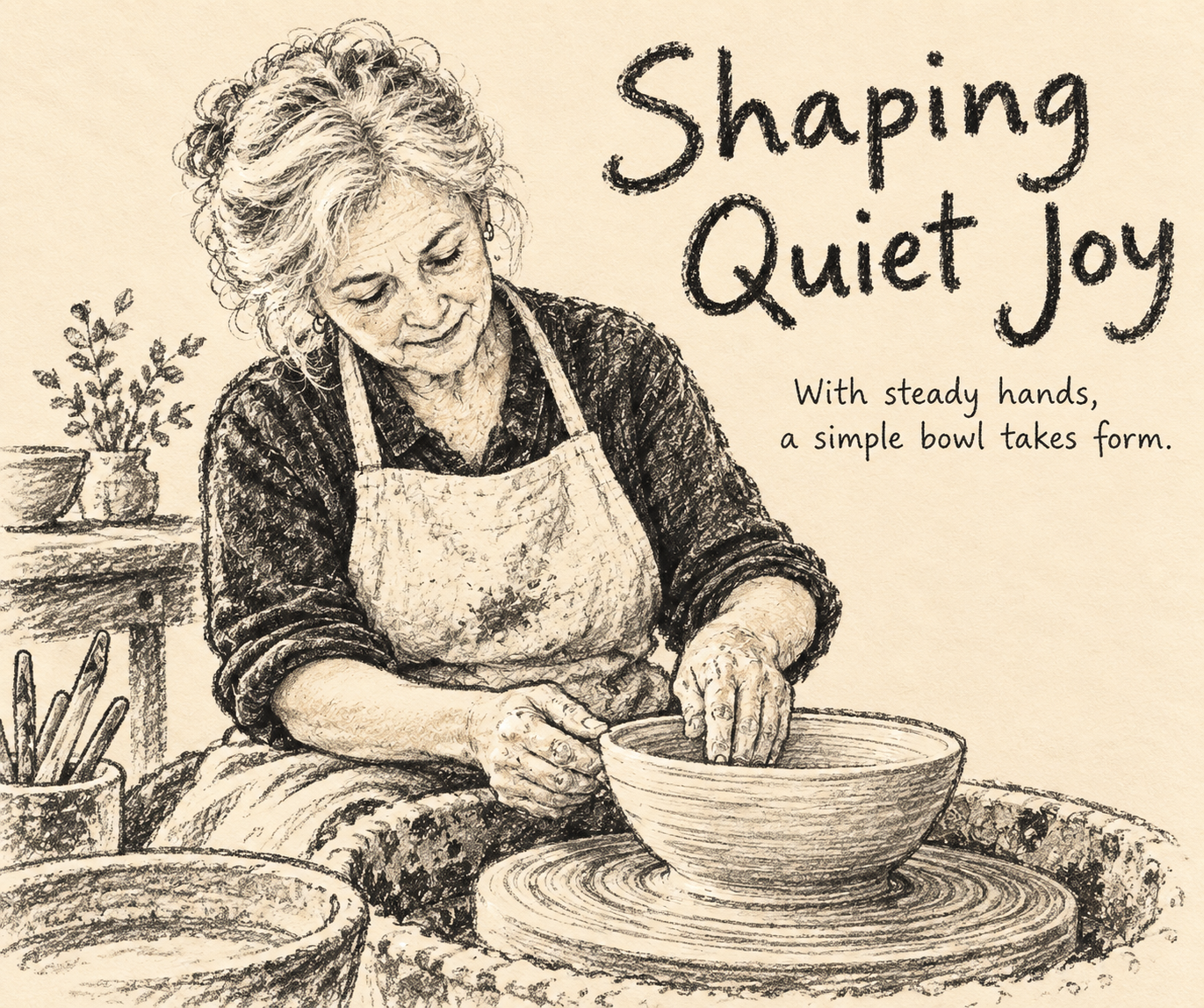
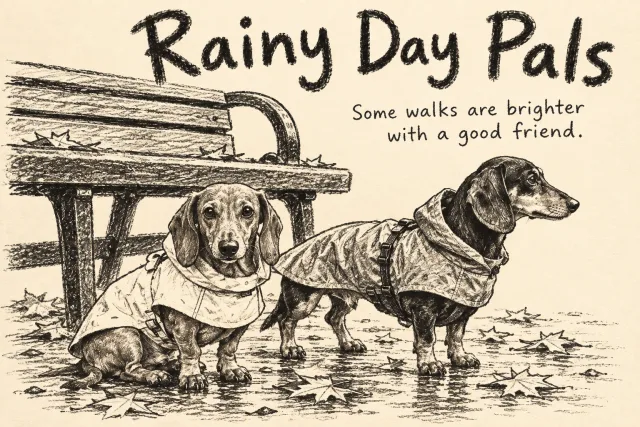
Prompt to Convert a Photo into a Monochrome Hand-Drawn Picture-Book Illustration
Prompt
Transform the uploaded photograph into a single monochrome, hand-drawn picture-book illustration on warm ivory paper, accompanied by an original English title and one short sentence. The photograph is the sole source of scene content. Do not include the photograph in the output or create a before-and-after comparison.

CONTENT AND CHARACTER DESIGN
Identify the main subjects and their visible action or interaction. Preserve their number, apparent ages, recognizable identity cues, poses, expressions, gaze directions, distinctive clothing features, and essential props. For animals, preserve their species, recognizable shape, and role in the scene.

Keep the relationships that make the moment understandable: hands holding objects, bodies sitting or leaning, subjects looking at something, and objects touching, containing, or supporting one another.

Simplify the subjects into an affectionate, slightly imperfect picture-book drawing. Favor expressive silhouettes and economical features over precise photographic anatomy. Children may have gently enlarged heads, rounded faces, small dot-like eyes, and minimal nose and mouth marks. Adults and older people must retain their age through simplified profiles, body language, hairstyles, eyewear, and selected age-related features. Do not turn everyone into a child or give everyone the same face.

Preserve the meaning of the action while reducing incidental detail. Draw only the body portions visible in the source; do not invent complete limbs outside its original crop. You may scale and reposition the subject group to make room for lettering, while retaining its relative arrangement, poses, and meaningful contact.

MARK-MAKING AND PAPER
Draw entirely with near-black, dry, grainy marks on lightly textured warm ivory paper. Give the strokes the visual character of a blunt black wax crayon or dry charcoal drawing: irregular pressure, rough deposits, broken edges, small skips, and exposed paper between marks.

Make the principal silhouettes stronger than interior details. Let contours wobble and break naturally. Avoid smooth, mechanically uniform outlines.

Build dark hair, clothing, fur, and other dark masses with directional scribbles, short slanted strokes, broad rubbing marks, and overlapping patches. Leave irregular paper-colored gaps throughout these dark areas. They should feel densely worked by hand rather than filled with smooth solid black.

Use unmarked paper to describe skin, pale clothing, white hair, foam, glass, and other light surfaces. Define them with economical contours and a few structural marks. Keep transparent objects readable through their outlines, openings, and essential contents rather than filling them black.

Suggest volume through sparse directional hatching and contrasting dark marks against open paper. Remove photographic lighting, reflections, skin texture, and continuous grayscale shading. Grain must follow the drawing strokes rather than appear as a uniform noise filter over the page.

BACKGROUND AND COMPOSITION
Remove nonessential photographic scenery. Replace it with generous warm ivory negative space. Keep only the support surfaces, environmental fragments, and action traces needed to explain the scene. Add a few loose ground strokes where useful to keep the subjects grounded.

Create an informal, balanced illustrated-page composition. Allow the drawing to sit slightly off-center when this helps the lettering and open space. Do not add unrelated people, animals, props, activities, or decorative motifs.

LETTERING
Generate one original English title based on the visible moment, usually two to four words. Draw it in large, rough, grainy handwriting, with slightly uneven letter sizes, relaxed spacing, and natural variations in angle and baseline.

Generate one brief English sentence, usually six to twelve words, in smaller, finer, slightly irregular handwriting. Keep the wording simple, warm, and relevant to what is visible. Do not invent names, family relationships, dates, seasons, locations, or personal history.

Place both text blocks in available negative space. Choose their location to suit the drawing rather than forcing a fixed layout. Keep faces, hands, animals, essential objects, and interactions unobstructed. Make the wording legible and correctly spelled.

Use exactly these two text blocks: one title and one short sentence. Add no extra labels, signature, watermark, or explanatory text.

OUTPUT
Produce exactly one finished illustrated page. Avoid photographic fragments, comparison panels, colored drawing marks, smooth vector fills, glossy digital rendering, elaborate tonal shading, dense scenery, and a photograph merely converted to black and white.
Input images
Summary
Use this with a single photograph of a person, an animal, or a moment you want to preserve. Keep actions, expressions, and relationships with objects, and redraw in a warm picture-book style with lines that evoke black crayon or charcoal. An English title and a short sentence will also be added.