
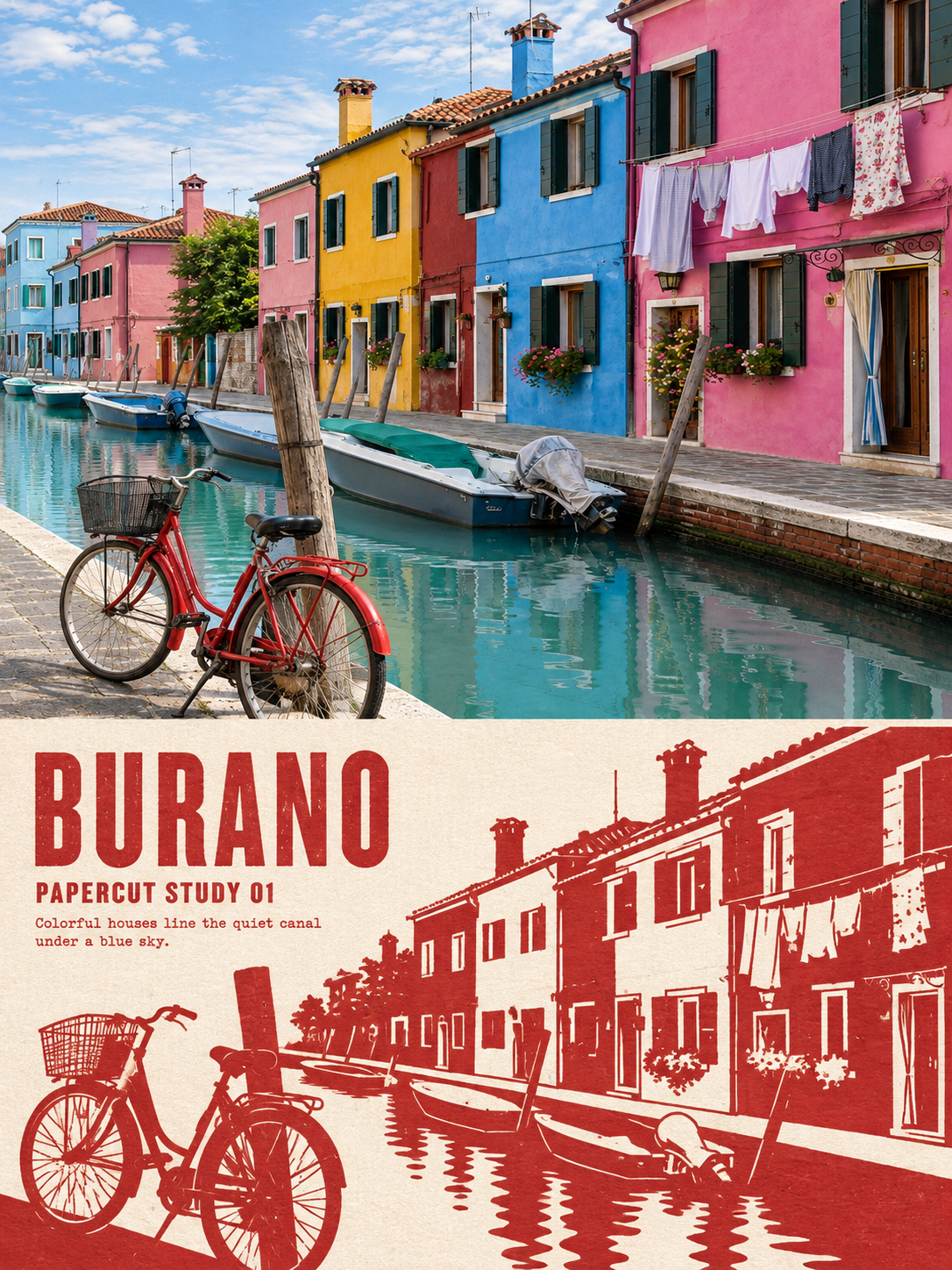
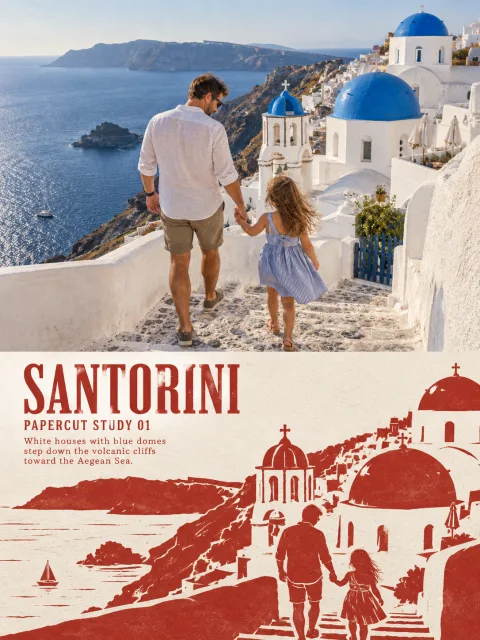
Poster-generation prompt to display travel photos paired top/bottom with vermilion landmark papercut
Prompt
Please create a separate high-end design poster for each travel photo I upload. Output each photo individually; do not combine multiple photos into the same frame.

Use an overall 3:4 portrait composition. The image should consist of the real photograph and a redraw of the same scene. The upper and lower areas should be approximately equal in height (close to 1:1), with a clear, straight, restrained horizontal boundary—do not feather, blur, blend, or allow material bleeding at the dividing line.

## Upper half: original photo

Faithfully preserve the subject identity, architectural structure, terrain relationships, number of people or animals, their poses, viewing angle, relative positions, real materials, natural light and shadow, and the original color atmosphere of the photograph.

Apply only light color grading appropriate for an art publication, architecture magazine, or travel photography, and add very fine film grain. The upper half must remain a clear, realistic photographic piece with substantial photographic area; do not turn it into an illustration, do not redraw the subject, replace the sky, move people, alter buildings, or add non-existent landmarks.

To fit the layout, you may naturally extend a small amount of sky, ground, or surrounding environment, but do not stretch, mirror, compress, copy, or distort the subject.

## Lower half: vermilion landmark papercut

Extract the most recognizable landmark subject from the same photo and reconstruct it as a single-color vermilion papercut with a modern editorial design sensibility.

Do not copy the full original framing of the photo, and do not simply convert the entire photo into a red silhouette. Actively remove complex backgrounds, repeated buildings, tiny panes, dense vegetation, billboards, cluttered pedestrians, and irrelevant surroundings. Keep only:

- the most recognizable overall contour of the landmark;
- building hierarchies, roof rhythm, or the ridgeline of peaks;
- key negative-space openings such as doorways, bridge arches, and windows;
- one necessary foreground relationship line;
- a minimal number of ancillary silhouettes that help convey the spatial context.

Use a secondary composition of “full-bleed impact + negative-shape carving.” The subject may be enlarged to 70%–105% of the redraw area height; parts of the contour may naturally extend beyond the frame, but you must readjust the subject’s scale, crop, and visual center—do not keep the same crop as the upper photo.

The subject must appear cut from a single continuous sheet of vermilion paper, not a collage of many small red icons. Use paper-white negative shapes to carve doors, eaves, bridge openings, canopy gaps, valleys, and sky, so that the red paper and the white ground together define the structure.

Papercut edges must be clear, sharp, and intact, with slight real paper fibers, knife-edge undulation, and hand-cutting imperfections. Small amounts of creasing or pressure marks are acceptable locally, but the overall feel should remain flat paper craft.

Do not add traditional celebratory window-flower motifs, floral-bird patterns, lace borders, symmetrical decorations, or Chinese New Year papercut elements. This is a modern landmark papercut editorial poster, not a festive ornament.

## Color and paper

The redraw portion should use only:

- a restrained, deep vermilion paper color;
- a warm natural off-white paper ground;
- minimal same-color tonal embossing or pressure marks.

The vermilion must not be too bright, too orange, or plastic-looking; it should approximate mineral cinnabar, aged ink paste, or matte dyed paper. The off-white paper carries sky, highlights, air, and spatial distance.

Intentionally leave about 20%–35% continuous paper-white empty space on one side or above the subject. The white space must create a clear contrast of weight and density with the vermilion subject—do not use templated white sidebars.

## Typography

Before generating, determine the following text from the real, visible place, building, or feature in the photo, and render it verbatim in the image:

- a main title of 1–3 English words; use the real place name when identifiable, otherwise use “LANDMARK” or a generalized title relevant to the subject;
- the material field: “PAPERCUT STUDY 01”;
- an observation sentence of 5–12 English words that only describes contours, directions, colors, or spatial relationships actually present in the photo.

Place the text together within the continuous paper-white area; do not scatter it evenly across the four corners. The main title must remain legible at chat-preview size.

Text should appear in the same color as the vermilion papercut, in a debossed letterpress, distressed ink-print, or condensed uppercase type, with slight paper tooth and ink gaps at the edges—as if printed on the same paper as the papercut. Do not use smooth floating digital typesetting.

Author names, signatures, social handles, URLs, QR codes, fictional brands, meaningless serial numbers, fake Chinese characters, or gibberish are prohibited.

## Overall tone

Modern, restrained, sharp, quiet, culturally identifiable, and collectible—like a landmark papercut study poster produced by an independent art publisher.

Strictly avoid: photorealistic lower panel, same-crop same-scale redraw, red photo filter, detailed multicolor illustration, decorative folk lace, symmetrical festival papercut, generic souvenir template, scattered icons, glossy plastic, 3D render, soft blurred edges, smooth vector shapes, excessive details, excessive text, missing source-photo comparison, distorted architecture, invented landmark, fake text, watermark.
Input images
Summary
Send the photo you want converted together with the prompt. A prompt that creates a poster combining the photo in the upper half and a monochrome vermilion Chinese papercut–style illustration in the lower half.