
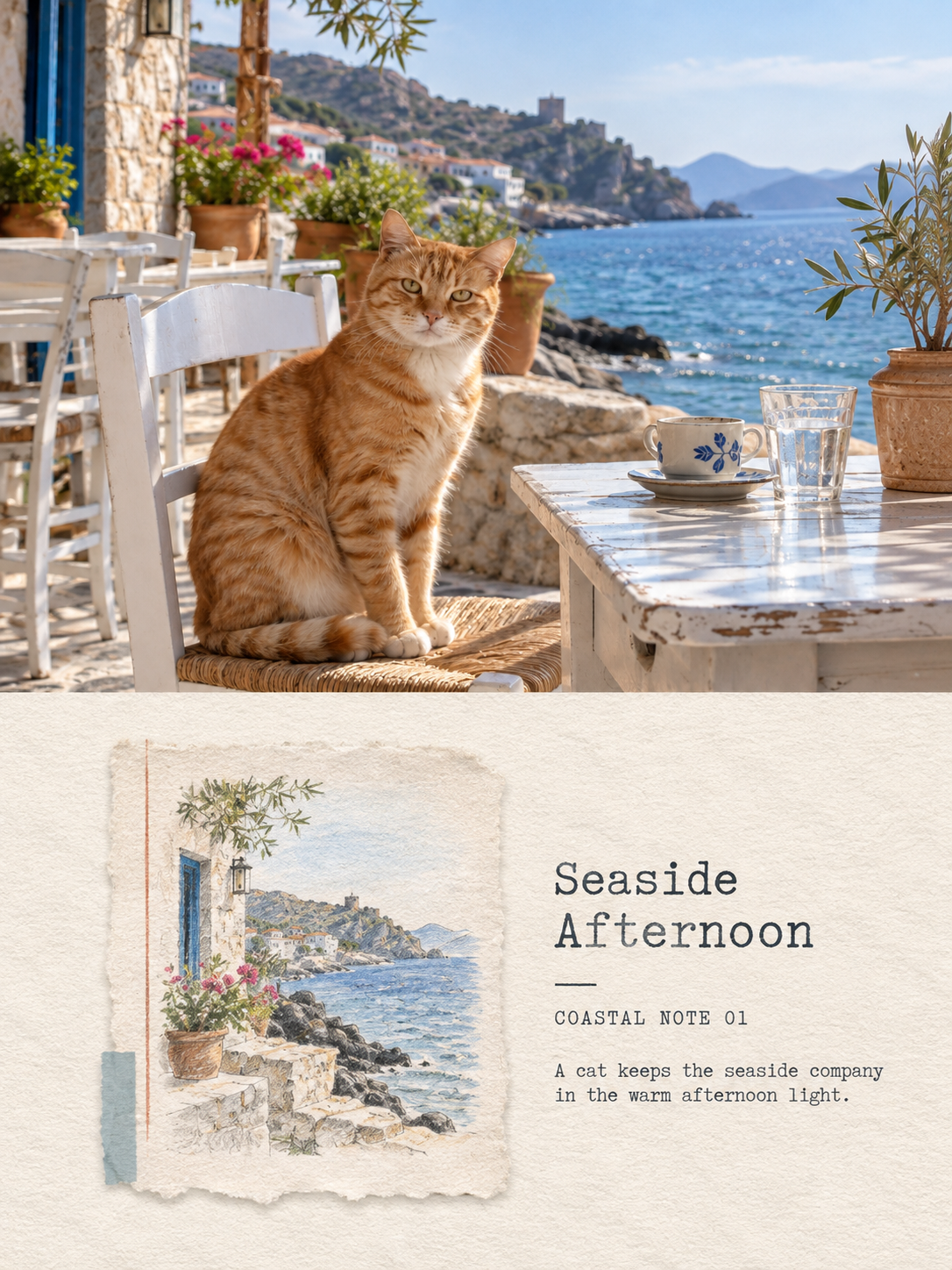
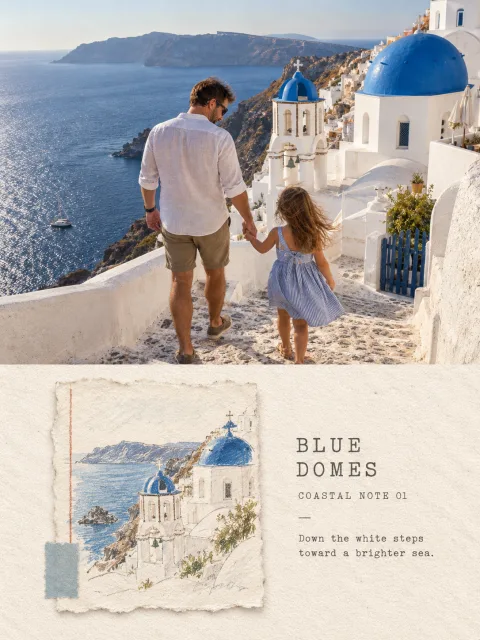
Coastal Memory Poster Generation Prompt — Preserve Travel Photos as Paper-Window Sketches
Prompt
Please turn each travel photo I upload into an independent
“PAPER WINDOW COASTAL MEMORY|Paper Window Coastal Memory”
high-contrast poster. Output each photo separately; do not create multi-image collages.

Use an overall 3:4 vertical composition. The original photo in the upper half should occupy about 48%–50% of the frame,
and the paper-window memory area below should occupy about 50%–52%. Use a clear,
straight, restrained horizontal boundary between the two areas—no gradients, feathering, or overlap.

The upper half must use the original photo itself, accurately preserving the subject identity, number of subjects,
people’s or animals’ poses, boat directions, building silhouettes, mountains and coastline,
spatial relationships, viewing angle, natural materials, real light and shadow, and the original color atmosphere.

Only apply light, travel-publishing-grade color grading and a very thin film grain.
To fit the vertical layout, you may reasonably crop or naturally extend sky, water, or ground and
non-subject environment, but do not stretch, distort, move, replace, or redraw the subject,
and do not use an AI‑reconstructed similar photo to pretend it is the original.

The lower half should use a large-area warm off-white textured watercolor paper as the full background,
with clearly visible cotton fibers, deckled edges, and subtle natural color variation.

The large blank area in the lower half is a primary compositional element—do not fill the paper with maps,
stamps, shells, tape, or decorative scrapbooking materials.

Place a small, vertical or near-vertical, naturally torn hand-drawn paper insert slightly left-of-center or slightly centered in the lower half.

The small paper insert typically occupies about 38%–45% of the width of the lower half and about 45%–58% of its height;
leave at least 45%–60% continuous, quiet, unmarked textured paper whitespace around it.

The torn edge must show real cotton fibers and slight physical thickness; use only soft, restrained contact shadows.
Do not make it into thick cardboard, a framed relief, a Polaroid, or a floating card.

Inside the small paper insert extract only the single most memorable travel anchor from the photo,
for example a boat, a windmill, a group of domes, a lighthouse, a pier segment, a seaside building, or a lone pedestrian.

Include two to four necessary environmental clues, such as a short stretch of shoreline, a strip of water,
a few masts, a ridge line, a few roofs, or some plants. Actively remove crowds, duplicate boats, dense buildings,
signs, window grids, clutter, and photographic noise.

Do not shrink the entire photo into the paper window, and do not reuse the original’s full crop, subject scale, or information density.

Rescale the main subject, reposition secondary elements, and adjust the paper-whitespace ratio so the core object reads
like an individually preserved observation rather than a coloured-pencil copy of the photo. Leave obvious unpainted areas
inside the small sketch as well; brush or pencil strokes should naturally stop before the torn edge.

Use a drawing medium dominated by tentative, fine, slightly handmade graphite pencil lines,
combined with dry colored pencil, light watercolor pencil, local paper scuffs, and broken strokes.

Extract and condense the color palette entirely from the original photo into a limited palette—e.g., gray-blue or teal of sea and sky,
warm stone and ochre for buildings and land, gray-greens for plants, and a single small highlight color from the original image.

Keep colors soft, faded, and slightly like old travel sketches; do not use high-saturation colors across the entire paper insert.

Add an extremely thin, slightly faded vertical red or warm-toned pencil line at the edge of the small paper insert,
and a small swatch of paper-colored patch taken from the photo palette in gray-blue, teal, or warm gray.

These elements are only for establishing a paper editorial rhythm—they must not become fixed brand marks,
and must not obscure the subject.

Include by default in the lower half a small set of minimal, accurate, and clearly readable English text, placed in the continuous whitespace to the right of or near the small paper insert. The text should include:

1. A scene or image title composed of 1–3 English words;
2. A field like “COASTAL NOTE 01” or “TRAVEL NOTE 01”;
3. A short observation sentence of 5–12 English words describing something that actually exists in the photo—weather, an action, a building, a boat, the sea, or spatial relationship.

Use restrained typewriter-serif, old letterpress, or narrow book-like serif fonts; letterspacing and line spacing should be slightly wide,
with edges allowed slight ink gaps and uneven pressure, as if directly printed on textured paper.

The main title must be clearly legible at normal chat-preview sizes and must not be reduced to a gray decorative line. Do not invent city names,
dates, coordinates, quotations, or historical information.

Overall mood: quiet, gentle, with real paper tactile quality and a sense of looking back after travel.
The upper half should retain the light and sound of the journey in progress; the lower half should feel like selecting one object from memory
and redrawing it on a small scrap of paper tucked into a book.

Avoid:
- Fully redrawing the entire scene in the lower half;
- Replacing with materials at the same crop and scale;
- Full-bleed watercolor backgrounds;
- Oversized hand-drawn inserts;
- Multiple torn-paper cards;
- Dense scrapbook collages;
- Smooth vector linework;
- Childlike cartoons;
- Commercial tourism icons;
- Accumulations of maps, stamps, shells, and tape;
- Heavy drop shadows;
- Plastic 3D effects;
- Fake Chinese characters or garbled text;
- Author names, signatures, logos, QR codes, URLs, or watermarks.
Input images
Summary
Upload a travel photo to generate a poster that places the original photo at the top and a hand-drawn sketch resembling a paper-cut window at the bottom. Send the image you want turned into a poster together with the prompt.