
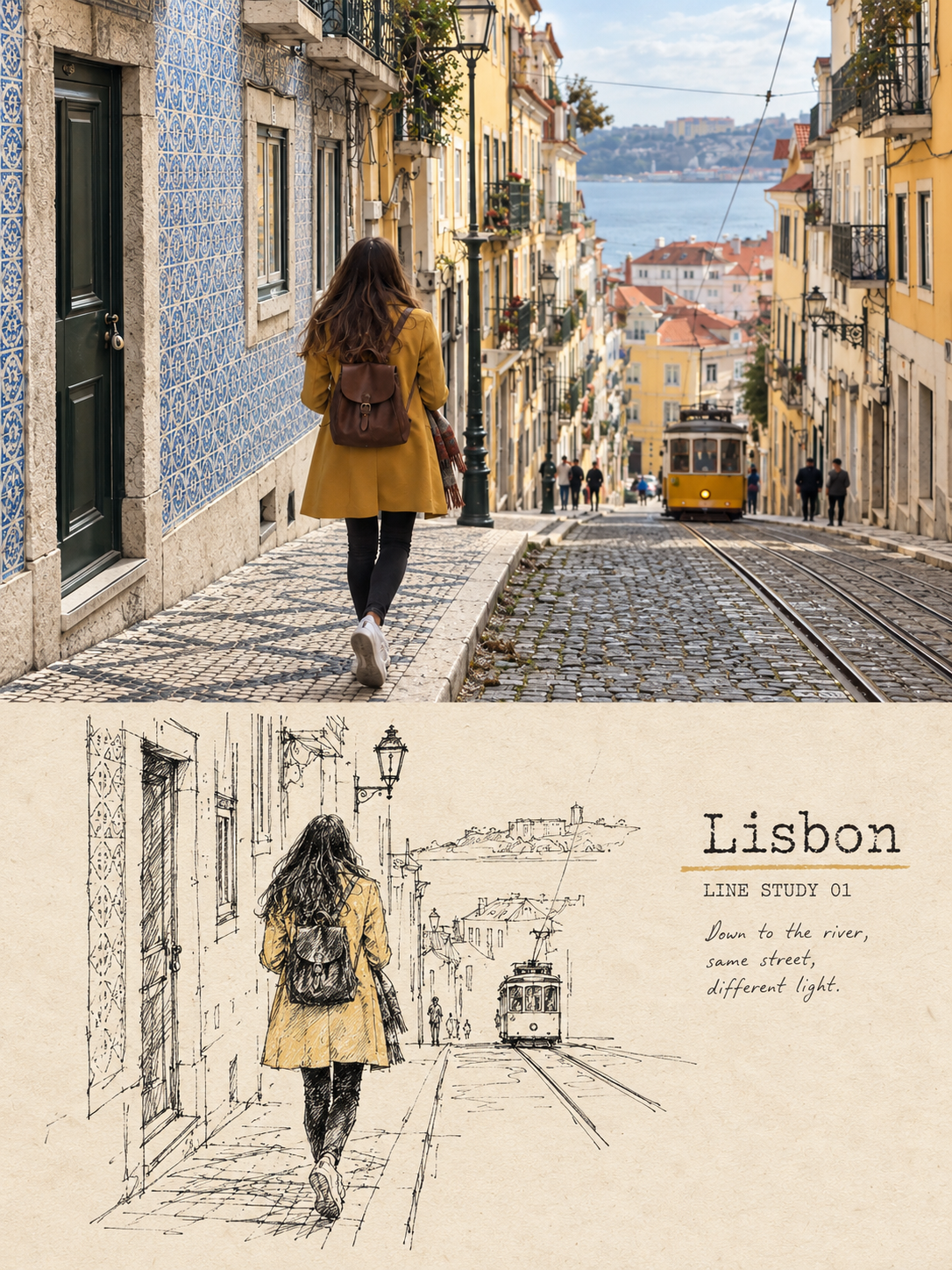
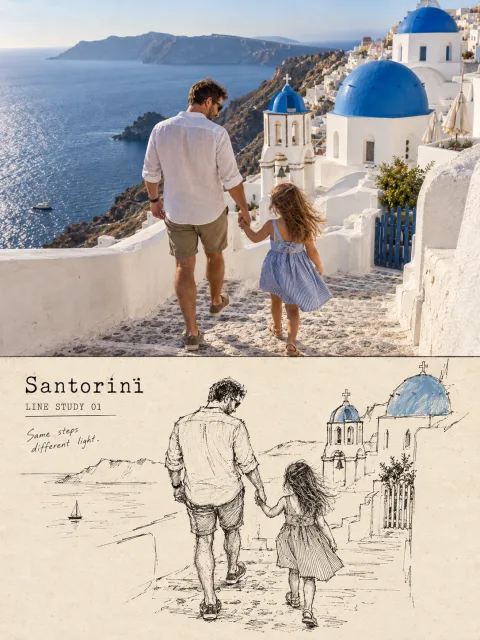
Prompt to Convert Travel Photos into Photoreal × Fragmented Line-Drawn Observational Posters
Prompt
For each travel photo I upload, create one independent high-end line-drawing travel poster. Output one poster per photo; do not create multi-image collages.

Use an overall 3:4 vertical composition to form a clear “upper photoreal photo + lower line-drawn background figure study” top/bottom contrast. Use a distinct, horizontal, restrained boundary between top and bottom; do not feather, tear, or gradient-blend, and do not allow the photo, lines, or text to cross the boundary.

The upper half must retain the uploaded photo itself. Accurately preserve the person(s) or subject identity, number, posture, direction of motion, main clothing colors, the relationship between buildings and street, viewpoint, perspective, real materials, natural light and shadow, and the original color atmosphere. Apply only subtle premium photographic color grading and an extremely fine film grain to give it the texture of travel magazines and art publications. To fit the aspect ratio you may naturally extend sky, ground, or surrounding environment, but do not stretch, distort, mirror, move, replace, or redraw the subject.

On the lower half, on warm off-white, aged-paper white, or light oatmeal paper, reorganize the same person and the same scene from the upper photo into a “line-drawn background figure study.” The person(s) remain the visual center, keeping original headcount, center of mass, direction of motion, mutual distances, hairstyle silhouettes, main clothing colors, and key identifying features such as backpacks; the street, buildings, sea or environment behind the figures should retain only minimal lines that indicate location and spatial direction. Do not fully redraw the entire background, and do not add people or landmarks that are not present in the original photo.

Linework must use an unstable black steel-nib pen, dip pen, or slightly-dry ink lines that repeatedly search for form: breaks, pauses, reversals, offset multiple lines, local re-drawing, variation in thickness, slight erasures, and unfinished line ends should all be clearly visible. The lines should read like an artist continuously correcting on-site, not like clean vector strokes, comic inks, or fashion quick-sketches. Where necessary use a very small amount of solid black shapes or dense hatch to anchor backpacks, hair, doorframes, or shadows, but do not build full tonal shading or large-area fills.

Compose by reduction, offset arrangement, or vertical reorganization. The linear subject should occupy approximately 38%–68% of the width of the lower half and may be biased to one side; leave at least 42% continuous aged-paper white around it. Keep only one or two ground lines, perspective lines, wall edges, or structural lines to support space—do not render an engineering grid. The tension between line and paper-white is more important than background completeness.

Color should be dominated by warm aged paper and single black ink. At most extract one very small area of pale color from the photo to use for clothing, a location mark, a short line, or a number; colored area must be less than 8% of the lower half. Do not use multi-color watercolor fills. The paper should show visible fibers, subtle grain, and a matte tactile feel like an old travel booklet.

In the principal blank area, add a small amount of accurate, legible editorial text: a short English title related to the place or subject; one line reading “LINE STUDY 01” or a place/object field; and one very short observational note. Use a small typewriter font, ink-missing stamped letters, or handwriting close to the linework, as if written directly on the paper. Do not let the text overpower the figure. Do not add author name, brand, logo, URL, false dates, signature, watermark, or garbled text.

Overall mood: fragmented black linework, repeated searching contours, sparse travel observation, warm archival paper, controlled negative space, one restrained accent color, handmade editorial study, quiet and intelligent travel memory.

Avoid: applying a generic line-art filter to the whole image; continuous smooth contours; vector strokes; polished fashion sketches; detailed facial features; anatomical correction; complete background rendering; dense architectural detail; full tonal shading; heavy watercolor or oil paint; 3D or anime styles; unrelated people; intimate pose constraints; author name, logo, URL, signature, watermark, or garbled text.

Most important rule: the upper half must be the directly comparable real photo; the lower half must be rendered only with broken, reversing, overlapping black lines that continuously search for form to re-abstract the same person and scene relationship. The style should come from the tension between linework and white space, not from any fixed depiction of relationships.
Input images
Summary
Keep the upper half of the travel photo photoreal, and render the lower half the same person and the same street relationship in interrupted, overlapping black pen lines to create a 3:4 vertical poster. Upload one photo that clearly shows the person and the surrounding place, and input the original text as-is. There are no replacement slots. Suitable for documenting streetwalking, travel records, and portrait snaps in a quiet art-publication style.