
Prompt to convert travel photos into black-ink architectural observation sketch posters
Prompt
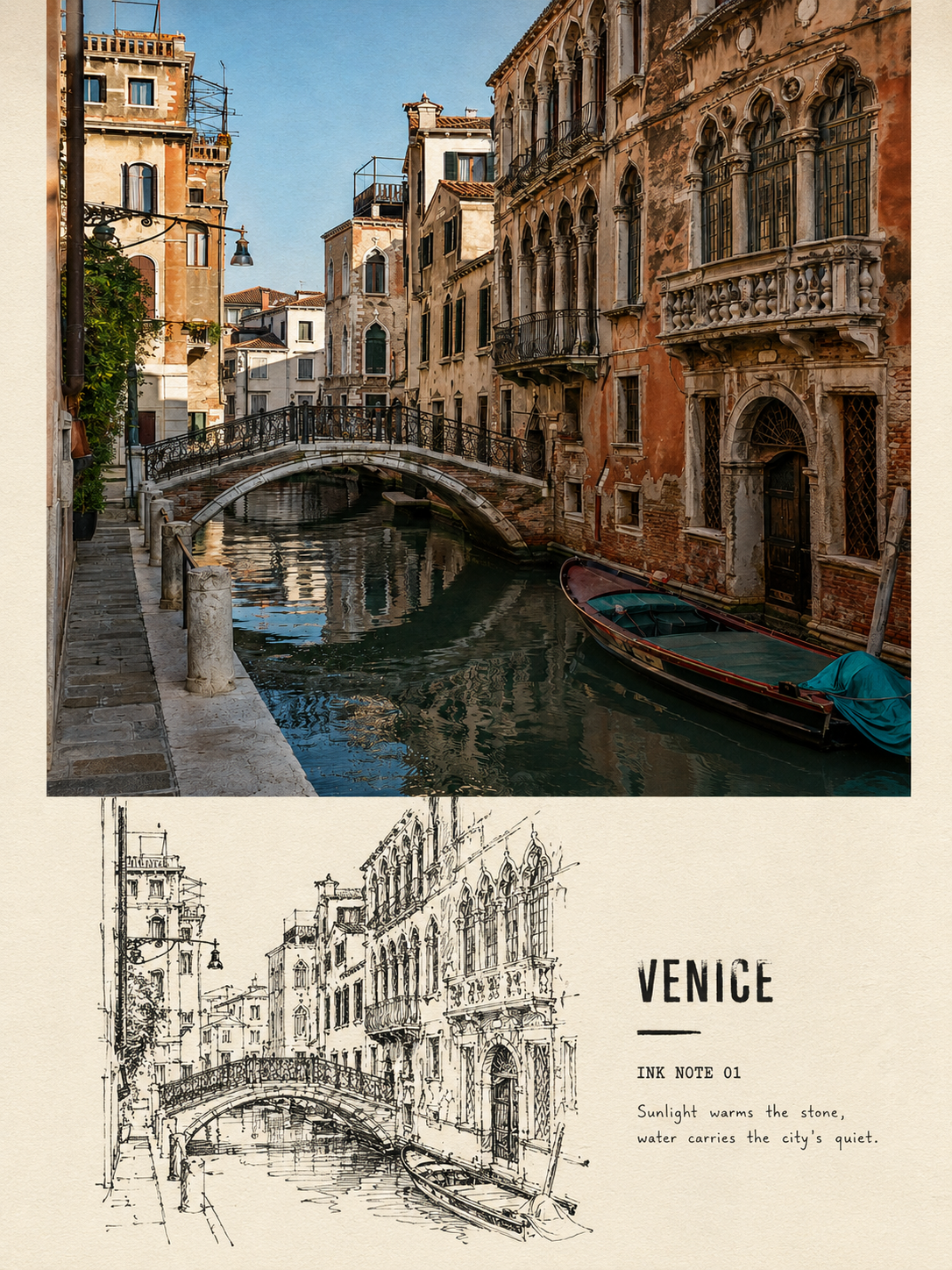
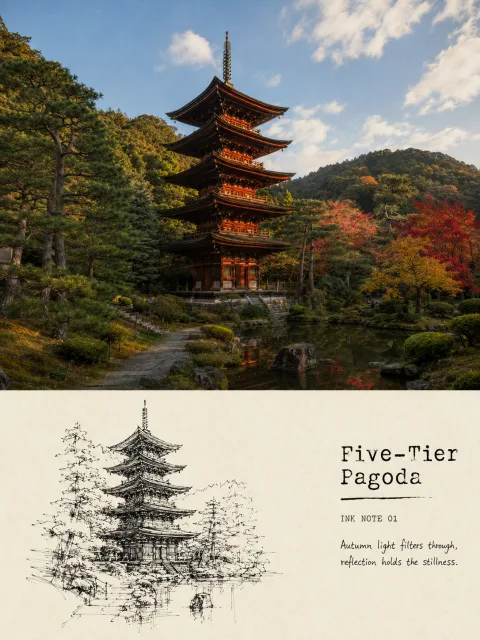
Please convert each travel photo I upload into an independent “Rapid-Line Architectural Observation” editorial poster — output one poster per photo. Do not create multi-photo collages; each photo must be output separately.

Overall use a 3:4 portrait composition. Retain the upper area with a substantive portion of the original photograph, accurately preserving building identity, number of floors, proportions, domes, towers, eaves, colonnades, arches, roads, waterfronts, people, and spatial relationships. Apply only slight art-publication color grading and a very thin film grain; do not stretch, move, reshape, or illustrate the photographic subject.

For the lower area, use warm natural off-white sketch paper and actively reduce, omit, and reorganize the building from the same photo into an unfinished rapid black-ink architectural observation. Do not fully replicate the photo background; keep only the decisive elements that identify the place: main outline, primary axis, roof or spire, rhythm of openings, and one to three necessary direction lines such as roads, bridges, waterfronts, or tree-shadow lines.

Draw using black fountain pen, technical/needle pen, and a small amount of dry brush-tip strokes. Contours should show repeated searching and correction; retain overlapping lines, double contours, hand tremor, pauses, broken ink, overdrawn lines, and un-erased trial marks. Establish colonnades with urgent vertical strokes and use short dense hatch lines to consolidate structural junctions. Concentrate black density only at a few key nodes — do not evenly saturate the entire building.

The architectural sketch should occupy about 45%–65% of the lower area’s width and 38%–58% of its height; it may be biased to one side. Preserve at least 40%–55% of continuous, intact paper white. Lines should naturally stop on the paper surface; boundaries must be clear but unfinished. Do not use digital feathering, soft focus, or regular rectangular picture frames.

In the lower area use only paper white and carbon-black ink. Do not add watercolor, gray washes, colored lines, or fixed accent colors.

Add a small amount of text based on the photo facts:
- A main title of 1–3 English words;
- The field “INK NOTE 01”;
- One on-site observation sentence of 5–10 English words.

Place the text within the continuous paper-white area. Use narrow type or plain handwriting with ink absorbency and slight gaps, and optionally accompany it with a short ink line. The title must be clearly readable at normal preview size and must not be reduced to a decorative gray line.

The overall result should feel like an architect or travel sketcher standing on site, quickly searching the structure: acute, brisk, restrained, incomplete, yet accurately preserving the building’s character.

Avoid: photo outline filters, CAD-style drafting, uniform fine hatching, academic pen drawings, full-page dense hatching, complete backgrounds, transparent watercolor, gray washes, colored pastels, softened edges, isomorphic composition copying, unreadable small text, author name, signature, logo, QR code, or watermark.
Input images
Summary
You can create 3:4 portrait posters that retain the travel photo at the top and reconstruct the lower part as an unfinished black-ink architectural sketch on warm off-white paper. Useful for finishing architectural photos or street-walk records for travel booklets, social media, or portfolios. Upload your travel/architectural photos and then send the original text as-is. An input image is required; there are no replacement slots.