
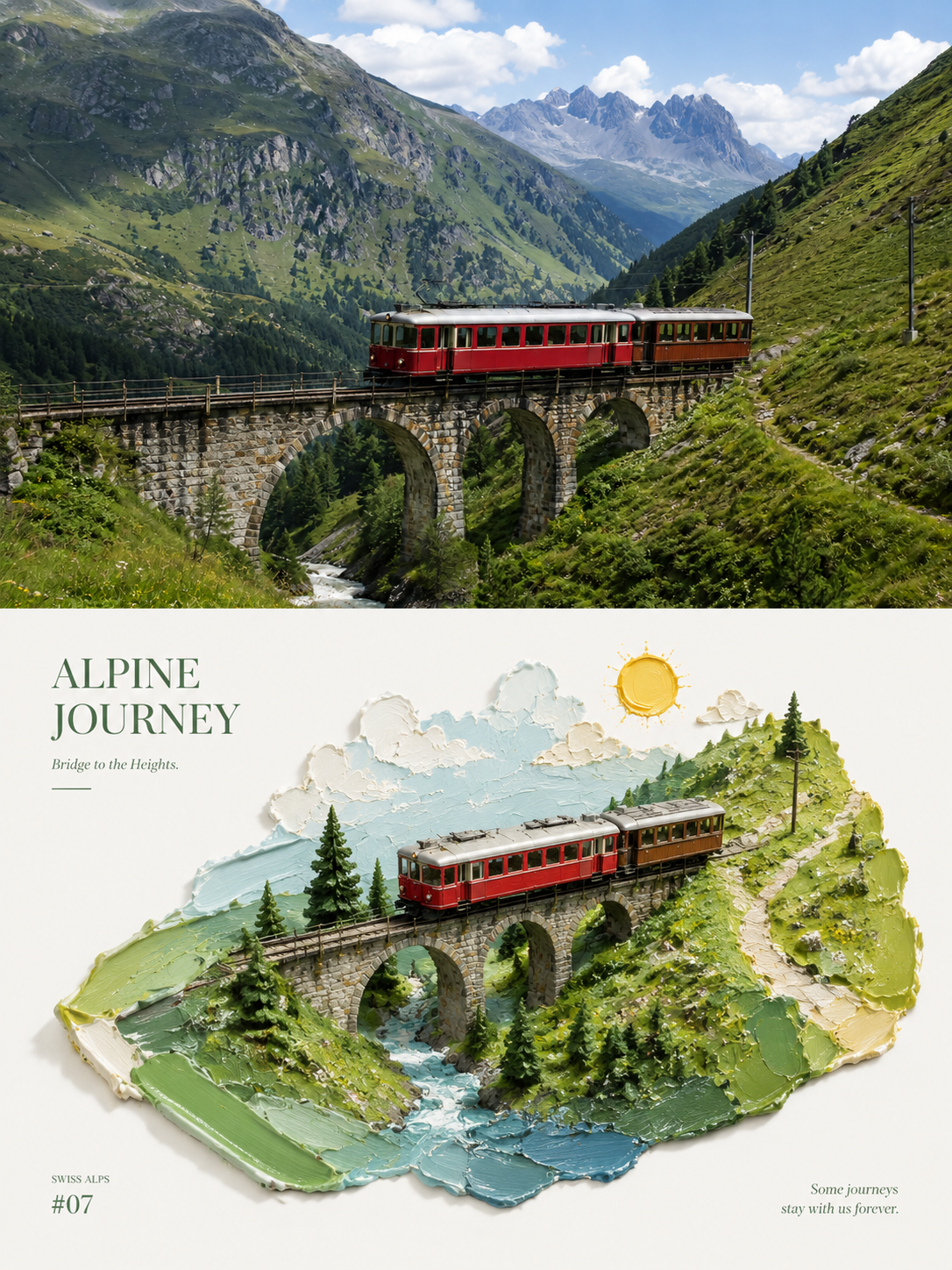
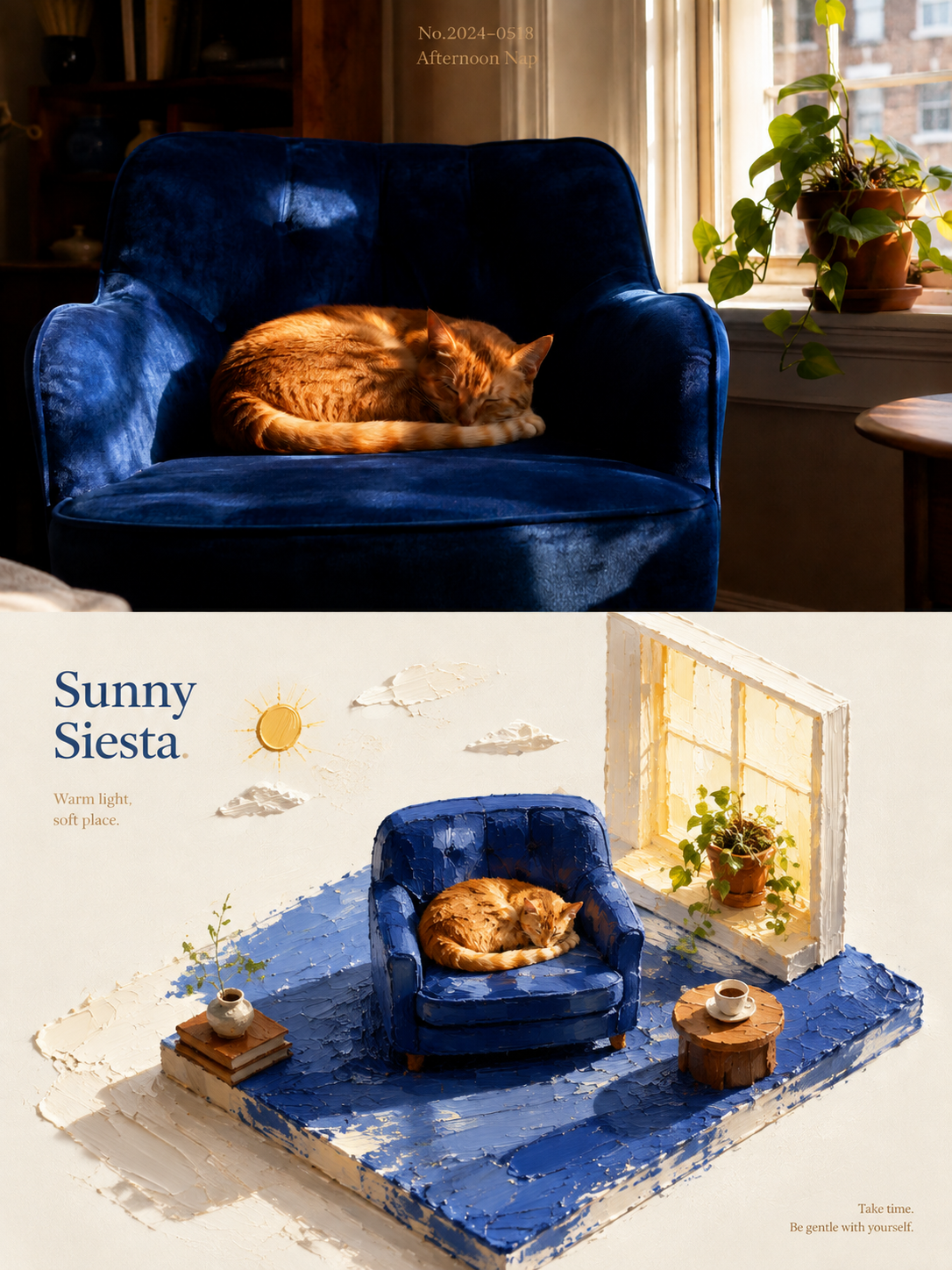

Poster: Render Travel Photos as 3D Miniatures with Thick-Impasto Painting
Prompt
For each photo I upload, create a separate high-end design poster — no multi-photo collages; output each photo individually. Use a 3:4 portrait layout; the upper and lower regions must each occupy exactly 1:1 height, each covering 50% of the frame.

The upper half should retain the original photograph, preserving the main structure, realistic texture, natural lighting and original color atmosphere, with only slight high-end photographic color grading to give it the feel of an art magazine, independent publication, or exhibition photography. To fit the canvas, you may naturally extend the sky, ground, or environmental background, but do not stretch, distort, or alter the subject.

For the lower half, extract the most identifiable elements of the photo — **subject, silhouette, pose, and narrative relationships** — and reconstruct them as an exquisite impasto micro-landscape using **isometric / axonometric 3D spatial logic**. The subject should not be a flat illustration but a three-dimensional miniature entity with clear volume, structure, front-back relationships, and a stable base; retain the subject's most critical identity features, and adjust viewpoint and proportions moderately so it reads more complete, clear, and sculptural within the unified axonometric space.

The subject must sit on a thematic color field formed by thick-impasto paint. The color field is not a plain rectangular backdrop but should be transformed from elements in the original image into spatial slices such as water surfaces, ground, roads, grass, light bands, shorelines, shadows, or other theme-related surfaces, and should naturally extend along the isometric perspective direction. The subject must have a believable spatial relationship with the color field — it may stand on, embed into, penetrate, extend through, reflect in, ripple, cast a shadow on, or slightly overlap the color block — so that two-dimensional impasto strokes and the three-dimensional subject connect cleverly.

Compose adaptively according to the subject's volume, orientation, and motion direction, establishing a professional spatial order with a slanted axonometric axis, stable center of gravity, front-to-back depth, and large areas of negative space. The subject should generally be placed at a key node of the color field rather than mechanically centered; the color block should guide the eye and extend perspective. If necessary, add a low-weight group of clouds, sun, plants, ripples, or abstract natural motifs to form foreground/background layers with the subject, but avoid creating a second visual center.

The painting language should fuse a three-dimensional miniature-model approach × impasto oil painting × real paper texture. Subject details should be delicate with clear volume, while surrounding areas retain visible palette-knife marks, thick paint buildup, undulating edges, and hand-applied brushstrokes. Clouds, water, ground, and light may have a bas-relief-like oil-paint thickness to create a tactile illusion of a real model standing on still-wet paint.

Extract from the top photo the **brightest, most vivid, and most representative colors of the subject's spirit** and remix them, increasing brightness, purity, and vitality. Use generous clean warm whites as breathing space, paired with translucent main colors and a few sunlight-like warm accents. The overall look should be bright, uplifting, fresh, and high-end; avoid muddy grays, dullness, Morandi-like desaturation, fluorescent tones, and cheap candy colors.

Introduce minimal text, distilled into a brief title derived from the subject, place, mood, or symbolism, with very minimal secondary copy, numbering, or micro-notes. Typography should be meticulous and restrained, aligning with the axonometric direction, the edges of impasto color blocks, or white-space areas, echoing the spatial perspective rather than appearing as an independently stuck-on title.

Overall present the visual relationship of **isometric 3D subject × impasto color-field × bright uplifting palette × real paper texture × large negative space**. Whether the subject is architecture, people, animals, plants, objects, vehicles, or natural scenery, it should convincingly “stand, grow, or exist” within the space formed by impasto color blocks. Avoid flat texture-mapped images, ordinary illustrations, plasticky CG, toy-model looks, and templated micro-landscapes.
Input images
Summary
Create posters where the upper half of the photo remains photographic, and the lower half is expressed as a three-dimensional miniature and thick-impasto painting.